



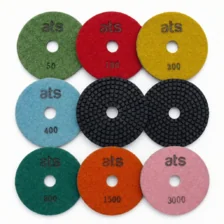
The standard diamond polishing sequence runs from a coarse grit through to a fine one without skipping steps: 50, 100, 200, 400, 800, 1500 and 3000, usually finishing with a buff. Coarse grits shape and flatten, the middle grits remove the scratches left by the previous pad, and the fine grits build the shine. Skip a grit and the scratches from the one before show through the final polish.
The standard grit sequence
Most polishing jobs follow the same run of grits: 50, 100, 200, 400, 800, 1500, 3000. You work each pad fully, covering the whole surface, before moving up to the next. Most diamond pad sets are sold to cover this range. A full wet set such as the Premium Wet Diamond Polishing Pads takes a surface from shaping to a high polish, and for a one-off job the 100mm Economy Wet Diamond Polishing Pads run the same #50 to #3000 range at a lower cost.
What the grit numbers mean
The number is the size of the diamond particles: a higher number means finer diamond and a finer scratch pattern. Polishing is really controlled scratching. Each pad removes the coarser scratches left by the pad before it and replaces them with its own finer set, and as the scratches get progressively shallower the surface starts to reflect light. That is why the order matters as much as the grits themselves.
Working through the grits step by step
50 and 100: shaping and flattening
These are the coarsest pads. They remove saw marks, flatten the surface and shape edges and profiles. They are aggressive, so use them only as long as you need to. If the surface is already flat you can skip 50 and start at 100. For heavy levelling on hard stone, a copper-bonded disc such as the Copper Bonded Diamond Polishing Pads sits between grinding and polishing and takes out deep marks faster than a resin pad.
200 and 400: removing the coarse scratches
This is the work-horse stage. These pads take out the scratch pattern left by the 50 and 100 pads. Do not rush it. Most poor finishes come from leaving the surface at this stage too early, because anything left behind here will still be visible after the fine pads.
800 and 1500: building the shine
Now the surface starts to reflect. Use even pressure and overlapping passes so you do not leave dull patches. By the end of 1500 the surface should have a clear sheen.
3000 and buff: the final polish
The 3000 pad brings up the full gloss. Finish with a buff pad or a polishing compound for a mirror finish on granite and marble.
Wet or dry pads?
Wet pads run cooler, raise far less dust and last longer, so they suit worktops, edges and any work where you can feed water. Dry pads are convenient where water is awkward, such as in-situ floors and edges. The Super Premium Dry Diamond Polishing Pads carry a very high diamond content for harder, more abrasive materials including granite, terrazzo, porcelain and hard marble. As a rule, use each pad as it is rated, and do not run dry pads under heavy water unless the product says you can.
By hand or by machine
For small areas, edges, profiles and touch-ups, hand pads are quicker to reach for than a machine. The Diamond Hand Polishing Pads run from #50 to #3000, so you can take a small repair from shaping right through to a shine by hand. For larger areas, machine pads on a backer are far faster. You can see hand pads, machine pads, drums and backers across the full diamond polishing range.
Using the pads: pressure, water and pace
The grit run only works if each pad is used properly. Keep the pad flat to the surface and use light, even pressure, because leaning on a pad does not polish faster, it just wears the pad and leaves swirl marks. Keep the machine moving in overlapping passes so you do not dwell in one spot and create a hollow or a dull patch. On wet pads, keep a steady trickle of water at the pad to flush the slurry and stop heat building, and on dry pads let the pad clear itself rather than clogging it with too much pressure. The backer matters too, with a firm backer for flat surfaces and a softer, flexible one for profiles and curved edges.
Looking after your pads
Diamond pads last longer if you treat them well. Rinse wet pads after use so slurry does not set hard in the diamond, and let them dry before storing. Do not run a fine pad over a surface that still has grit from a previous step on it, because trapped grit drags deeper scratches across the finish. Store pads flat so they do not curl, and keep your grits clearly labelled so you never skip or repeat a step by mistake.
When can you skip a grit?
You can skip the coarsest grit if the surface is already flat and does not need shaping, starting at 100 or even 200. You should not skip the middle grits. Jumping from 400 straight to 1500 leaves a scratch pattern the fine pads cannot remove, so the polished surface looks hazy rather than glossy. If you are unsure, work every step in order.
Matching the run to the finish you want
You do not always need to go all the way to 3000. Stop around 400 to 800 for a honed, matt look, take it to 800 to 1500 for a satin sheen, and run through 3000 and a buff for a full gloss polish. Harder materials such as granite, porcelain and terrazzo want higher diamond content pads, while softer marble and limestone polish up with less work.
FAQ
What order do diamond polishing pads go in?
From coarse to fine without skipping: 50, 100, 200, 400, 800, 1500, then 3000, usually finished with a buff. Each pad removes the scratches left by the one before, so the order matters as much as the grits themselves.
Can I skip grits to save time?
You can skip the coarsest grit if the surface is already flat, but not the middle ones. Jumping from 400 to 1500 leaves scratches the fine pads cannot clear, and the finish looks hazy instead of glossy.
What grit gives a high gloss finish?
Work all the way through 3000 and finish with a buff pad or polishing compound. Stopping at 800 gives a satin sheen and stopping around 400 gives a honed, matt look, so choose the final grit to match the finish you want.
Do I use wet or dry polishing pads?
Wet pads run cooler, raise less dust and last longer, so they suit worktops and edges with a water feed. Dry pads are handy for floors and in-situ work where water is awkward. Use each type as it is rated.
How many grits do I actually need?
A full set from 50 to 3000 covers shaping through to a mirror polish. For a honed or satin finish you may only need up to 400 or 800, so you can use a shorter run if you never go to full gloss.
Why does my stone still look scratched after polishing?
Almost always a skipped or rushed grit. If a coarse scratch pattern is left in, the finer pads polish around it rather than removing it. Drop back a few grits and work each pad fully before moving up.


 Your Basket