



Granite and quartz behave differently under a blade, so the fitting kit you need is not the same for both. Granite is a natural stone that is forgiving to cut and shape, while engineered quartz is harder on tooling and more prone to chipping. If you fit kitchens and want to take on simple worktop work yourself, this explains what each material demands and which kit covers it.
Granite versus quartz: why the tooling differs
Granite is a natural igneous stone. It cuts cleanly with general-purpose stone diamond tooling and polishes back to a shine without much fuss, which is why a basic kit gets a competent fitter a long way. Quartz worktops are engineered from crushed quartz bound in resin. That resin content makes them sensitive to heat and the dense quartz makes them harder on blades, so quartz-specific tooling is matched to the material to avoid burning the resin or chipping the edge.
The practical upshot: do not assume a granite kit will give a clean result on quartz. Match the kit to the worktop. You can see both grouped in the worktop and sink fitting kits category.
What a granite worktop fitting kit covers
The granite worktop fitting kit for kitchen fitters is a starter pack aimed at the fitter who wants to take on simple granite installations rather than sub-contracting every cut. It brings together the cutting and polishing tools you need to trim, shape and finish a granite top on site, so you can handle straightforward jobs without a full stone-mason workshop.
For most fitters, this is the sensible first kit: granite is the easier material to learn on, and the skills carry over. Start with simple straight cuts and edge polishing before you move on to cut-outs.

The blade does the heavy lifting
The single tool that most affects your finish is the cutting blade. A blade matched to the material cuts cleaner, runs cooler and chips less, which on a worktop is the difference between a saleable edge and a re-do. For named quartz products there are blades made specifically for them: the Bushboard M Stone, Max Top or Howdens quartz diamond blade is built for those engineered materials rather than borrowed from a general stone kit.
For internal cut-outs and curves, a straight blade only takes you so far. Diamond jigsaw blades let you follow a marked line into a sink or hob aperture where a circular blade cannot reach, which keeps the cut-out neat without over-running the corners.
What a quartz fitting kit covers
Quartz needs tooling matched to the brand and density of the material. The Max Top quartz fitting kit is designed specifically to cut, shape and polish Max Top quartz worktops, so the blade and polishing tools are suited to that material rather than improvised from a stone kit. If you are working with a named quartz product, a kit built for it takes the guesswork out of speeds and finish.
Quartz also rewards patience. Keep the blade cool, do not force the cut, and let the diamond do the work. Rushing quartz is the quickest route to a chipped edge or a burn mark in the resin.
Sink cut-outs and undermount work
Sink openings are where worktop fitting gets technical, because a cut-out concentrates stress at the corners and an undermount needs the exposed edge cut, shaped and polished to a finished standard. The undermount granite sink fitting kit brings everything to cut, shape and polish an undermount sink cut-out in granite together on a single 50mm M14 fitting, which keeps tool changes down and the work flowing.
Take your time on the internal radii at the corners. Relieving the corners properly is what stops a cut-out cracking under thermal stress once the kitchen is in use.
Drainer grooves
Drainer grooves are a finishing detail that lifts a job from competent to professional. The drainer groove kit pairs a cutting flute wheel with a set of polishing wheels, so you cut the groove and bring it to a polished finish in one consistent process. Cut grooves dry-run first to check spacing and fall toward the bowl, then commit.
Polishing back to a finish
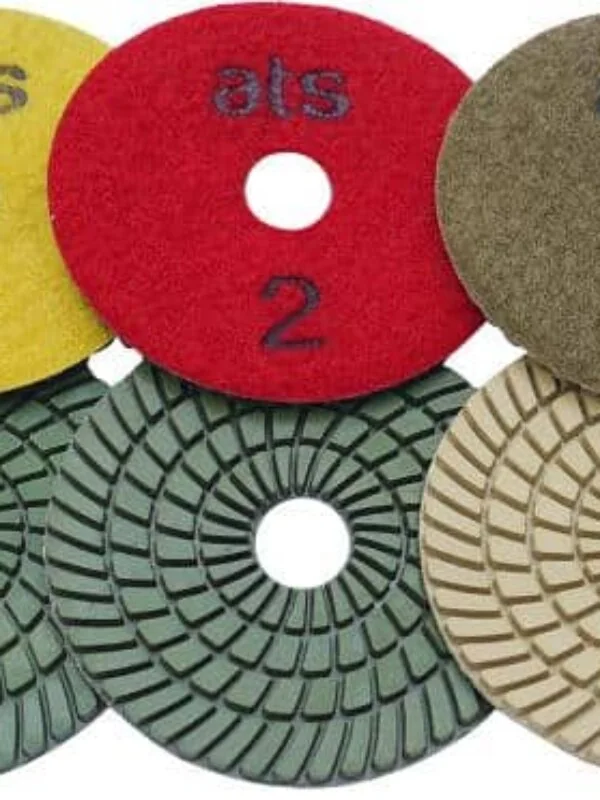
Whatever you cut, the edge has to come back to a polish that matches the factory face. A set of diamond hand polishing pads takes you from a ground edge to a gloss, working through each grit in turn without skipping. Both granite and quartz respond to a methodical grit sequence, and skipping a step shows up as a hazy edge under kitchen lighting.
Work wet where the pads allow it. Water clears the swarf, keeps the surface cool and lets you see the true polish developing rather than a slurry-covered guess. Wipe the edge down between grits so you are not dragging coarse grit into a finer pad.
Common mistakes to avoid
The faults that come up most often are rushing the cut, skipping grits and letting the tooling overheat. Forcing a blade through quartz to save a minute chips the edge and can burn the resin, neither of which polishes out. Jumping from a coarse to a fine grit leaves a hazy band that catches the light. And running any diamond tool dry and hot, when it could be cooled, shortens its life and degrades the finish. None of these save time once you account for the re-work.
Which kit should a kitchen fitter buy first?
If you mostly fit granite, start with the granite worktop kit and add the sink and drainer kits as the work comes in. If your customers specify a named quartz, buy the kit built for that quartz rather than trying to adapt stone tooling. Either way, build up from straight cuts to cut-outs as your confidence grows, and keep every blade and wheel cool. Heat is the common enemy on both materials.
FAQ
Can I use the same fitting kit for granite and quartz?
Not reliably. Granite cuts and polishes with general stone tooling, while quartz is denser and heat-sensitive because of its resin content, so it needs tooling matched to the material. Using a granite kit on quartz risks chipping and burnt edges.
Is granite or quartz easier to fit?
Granite is generally more forgiving for a fitter learning worktop work. It cuts cleanly and polishes back without much fuss. Quartz is harder on tooling and less tolerant of heat, so it rewards experience and a careful, unhurried approach.
What is the M14 fitting on these kits?
M14 is the standard threaded spindle on 115mm and 125mm angle grinders and polishers. Tools on a 50mm M14 fitting screw straight onto that spindle, so you can move between cutting and polishing with minimal tool changes.
Do I need a special kit for undermount sinks?
An undermount cut-out exposes a finished edge that has to be cut, shaped and polished, so a dedicated sink kit that bundles those tools makes the job far simpler than assembling tools piecemeal.
How do I stop a sink cut-out cracking?
Relieve the internal corners with a proper radius rather than a sharp corner, take the cut steadily and keep the tooling cool. Sharp internal corners concentrate stress and are the usual cause of a cut-out failing later.
Can a kitchen fitter realistically do their own stone work?
Yes, for simple installations. The starter kits are built for fitters who want to handle straightforward granite and quartz jobs in-house. Build up from straight cuts and edge polishing before taking on sink cut-outs and drainer grooves.


 Your Basket