



Diamond drill bits fall into four families that UK tradespeople reach for day to day: electroplated holesaws, dry vacuum-brazed drills, sintered and crown-segment drills, and M14 grinder-mounted drills. The right one depends on the material you are boring, the hole size, and whether you are drilling by hand or off a grinder. This guide explains how each type works and where it earns its place.
The short answer: which drill for which job
If you are cutting tap, waste and fixing holes through tiles, an electroplated holesaw is the cheapest sensible start. For repeat work in porcelain, a dry vacuum-brazed drill lasts far longer and cuts faster. For glass and very hard porcelain, a thin-wall sintered bit gives the cleanest break-through. And when you need larger diameters or deeper holes, an M14 drill that screws onto an angle grinder gives you the speed and torque a cordless drill cannot.
Browse the full range in the diamond drilling category, then match the bond type to your material using the sections below.
Electroplated diamond holesaws
Electroplated bits carry a single layer of diamond bonded to the steel body with nickel. That single layer cuts fast and free when new, which makes these the go-to for occasional drilling. They bore clean holes through porcelain, ceramic, glass, marble and slate up to around grade 5 hardness, so they cover most bathroom and kitchen tile work.
The trade-off is lifespan. Once that single diamond layer wears, the bit is spent, because there is no fresh diamond underneath. That is fine for a tiler cutting a handful of holes per job, and it keeps the cost per bit low. The electroplated diamond holesaw drills are a low-cost way to cut tap, waste and fixing holes on site without committing to a premium bit.
Keep them cool. Run at a moderate speed, ease off the pressure, and wet the bit where you can. Heat is what strips the plating and ends the bit early.
Dry vacuum-brazed diamond drills
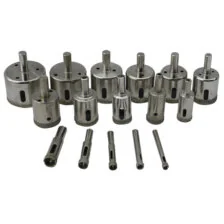
Vacuum brazing fuses the diamond to the steel in a high-temperature furnace, which holds the grit far more securely than plating. The result is a drill that cuts dry, runs aggressively, and keeps cutting long after an electroplated bit would have given up. For a tiler or fitter drilling porcelain day in, day out, this is the workhorse.
The dry porcelain diamond drill bits with easy coupling are made for use in a standard drill, while the M14 versions screw straight onto an angle grinder for bigger holes. A useful detail on the larger sizes is working length: the vacuum-brazed dry diamond drill with a 50mm working length gives you 20mm more depth than a standard holesaw from 16mm diameter upward, which matters on thick porcelain slabs and stacked tiles.
Because they cut dry, these bits suit on-site work where running water is awkward. Pair them with dust extraction rather than flooding the cut.
Sintered and crown-segment diamond drills
Sintered bits have diamond mixed all the way through a metal matrix, so as the tool wears, fresh diamond is constantly exposed. That gives the longest life of all and the most predictable cutting in the hardest materials. Thin-wall sintered drills are ideal for glass and very hard porcelain, where a thin kerf reduces the chance of chipping the face. See the thin-wall glass and hard porcelain drill bits for that work.
Crown-segment drills take the same idea into larger, deeper holes, with segments brazed to a tube for a generous depth of cut. They are the choice when you need to go right through thick stone or stacked material in one pass.
What the M14 fitting actually changes
M14 is the standard threaded spindle on 115mm and 125mm angle grinders and polishers across the UK. An M14 drill screws straight onto that spindle, so you swap the drill in seconds with no chuck. The advantage is power: a grinder spins faster and pulls harder than most cordless drills, so larger-diameter holes that would stall a drill cut cleanly off a grinder.
If you have a drill with a hex chuck but want to run an M14 bit, an M14 to hex adapter bridges the two. One word of caution: a grinder spins fast, so for large diameters keep both hands on the tool, start the hole at an angle to seat the cut, and respect the higher torque.
Dust control while drilling
Dry drilling in porcelain, stone and concrete produces fine dust you do not want to breathe. The cleanest fix is to capture it at the hole. A DrillDuster extractor shroud sits against the surface and draws dust away as you bore, taking drill sizes up to 82mm diameter. Connect it to a workshop vacuum and you keep the work area clean and your lungs out of the dust.
How to get the longest life from any diamond drill
Whatever bond you choose, a few habits make the bit last. Keep the speed sensible: too fast generates heat, too slow polishes the diamond rather than cutting. Let the tool find its own pace rather than forcing it, because diamond drills cut by abrasion and pressure only adds heat. Manage that heat with water or extraction wherever you can. And start the hole cleanly by seating the edge before bringing the drill square, which stops the bit skating and chipping the surface. A drill that is cared for this way will outlast one that is run hot and hard several times over.
Matching the bit to the material
As a rule of thumb: glass and very hard porcelain favour thin-wall sintered bits; everyday tile holes suit electroplated holesaws; repeat porcelain work pays for itself with dry vacuum-brazed drills; and large or deep holes belong on an M14 fitting off a grinder. Whatever you choose, keep the bit cool, let the diamond do the cutting, and do not lean on the tool. Diamond drills cut by abrasion, not force, and excess pressure only generates heat and wears the bond faster.
FAQ
What is the difference between electroplated and vacuum-brazed diamond drills?
Electroplated drills carry a single layer of diamond held on with nickel, so they cut fast when new but wear out once that layer is gone. Vacuum-brazed drills fuse the diamond in a furnace for a far stronger hold, so they cut more aggressively and last considerably longer, which suits repeat work.
Can I use a diamond drill in an ordinary drill?
Yes. Electroplated holesaws and easy-coupling dry porcelain drills are made to run in a standard drill. For larger or deeper holes, an M14 drill on an angle grinder gives more speed and torque than most cordless drills can deliver.
Should I drill tile wet or dry?
Both work. Wet drilling keeps the bit cool and extends its life, which is easy at a bench. On site, dry vacuum-brazed bits paired with dust extraction are often more practical. The key with any diamond drill is to manage heat, since heat is what kills the bond.
What does M14 mean on a diamond drill?
M14 is the threaded spindle size on standard 115mm and 125mm angle grinders and polishers. An M14 drill screws directly onto that spindle, letting you run larger-diameter holes off a grinder rather than a chuck.
Why does my diamond drill stop cutting?
Usually it has glazed over from heat or polished material. Reducing pressure, lowering the speed and adding water or extraction helps. On a worn electroplated bit, the diamond layer may simply be spent, in which case the bit needs replacing.
How do I stop tiles chipping when I break through?
Use a thin-wall sintered bit for the cleanest kerf, start slowly, and ease right off the pressure as you reach the back face. Supporting the tile from behind where possible also reduces break-out.


 Your Basket